
How to grow mushrooms at home? - Intermediate Level
Want to prepare your own mushroom-growing blocks at home?
Growing mushrooms is a fun way to explore this wonderful organism. It is a process that teaches us a lot about the role of mushrooms in nature.
01Choosing the substrate
To grow mushrooms, we must first answer one fundamental question: what do mushrooms eat?
Most easily grown mushrooms are found growing in nature on trees or fallen logs and branches. These mushrooms are primary decomposers: by feeding on dead wood, they enable its decomposition.
The substrate on which we will grow the mushrooms will therefore be a wood-based substrate. Straw can also be used as an alternative.
The substrate base
Sawdust, wood pellets for stoves, or straw pellets: these will provide the raw material for our production substrate.
For larger harvests
To achieve larger and larger harvests, it is recommended to add a nutrient compound, such as wheat bran, to the substrate.
Must be sterilized
In a pressure cooker, or in an atmospheric pressure steam sterilizer for a long time.
Does not need to be sterilized
For example, composed only of wood pellets. It is still advisable to pasteurize it using one of the techniques we will list shortly.
02Hydration
The last fundamental aspect of preparing an excellent substrate is its hydration. It must be precise, because mycelium has difficulty growing in an environment that is too damp or too dry. Furthermore, a substrate that is too damp, with water deposits, can promote the growth of competing organisms.
60% water
The substrate should be hydrated to 60%. What does that mean? That 60% of the final weight of your block must be composed of water.
If, for example, you are preparing a 2.5 kg block with wood pellets:
2.5 kg
1,500 g
1,000 g
Now all you need to do is put the water and the chosen material inside a container. If you need to sterilize your substrate, we recommend using autoclavable bags for growing mushrooms.
- They are resistant to high temperatures.
- They have a filter that protects the substrate from contaminants once inoculated and sealed, while also allowing the exchange of oxygen necessary for mycelium development.
- The presence of the filter justifies the use of these bags even for unsterilized substrates.

03Sterilizing the substrate
1 bar for at least 1.5 hours
Fold the bags well without sealing them and place them in the pressure cooker. If the cooker reaches 1 bar, sterilize for at least 1.5 hours; preferably, if the volume of water in the cooker allows, go up to 2 hours.
Boiling water on the pellets
Hydrate the unsupplemented pellets with the right amount of boiling water. Pour the water over the pellets already placed in the bag, try to close the bag by folding it over the folds, and wait for it to cool completely before inoculating.
Want to grow mushrooms on a highly nutritious substrate but don't have the tools to sterilize it?You can buy it already prepared and sterilized, ready to be inoculated.
Our most productive substrate →
04Inoculation
The last step is inoculation. For this, you will need Grain Spawn / Fresh Mycelium of the species you want to grow.

Your grain spawn bag will very likely arrive very compact. Before using it, you will need to separate all the grains well without opening the bag. Open it only when you are ready to inoculate!
at least 10%
of the total weight of the block. In the previous example, for a 2.5 kg block, we want to use at least 250 g of grain spawn.
Be generous with the spawn
For unsupplemented substrates, we recommend being generous: the spawn will provide more nutrients to your mushrooms, helping you get larger harvests!
- Make sure the substrate is not hot and pour the grain spawn inside the bag.
- Close the bag with a heat sealer, or simply fold the top edge over itself a couple of times and secure it with binder clips.
- Mix the substrate well with the grain spawn, so that it is distributed as evenly as possible.
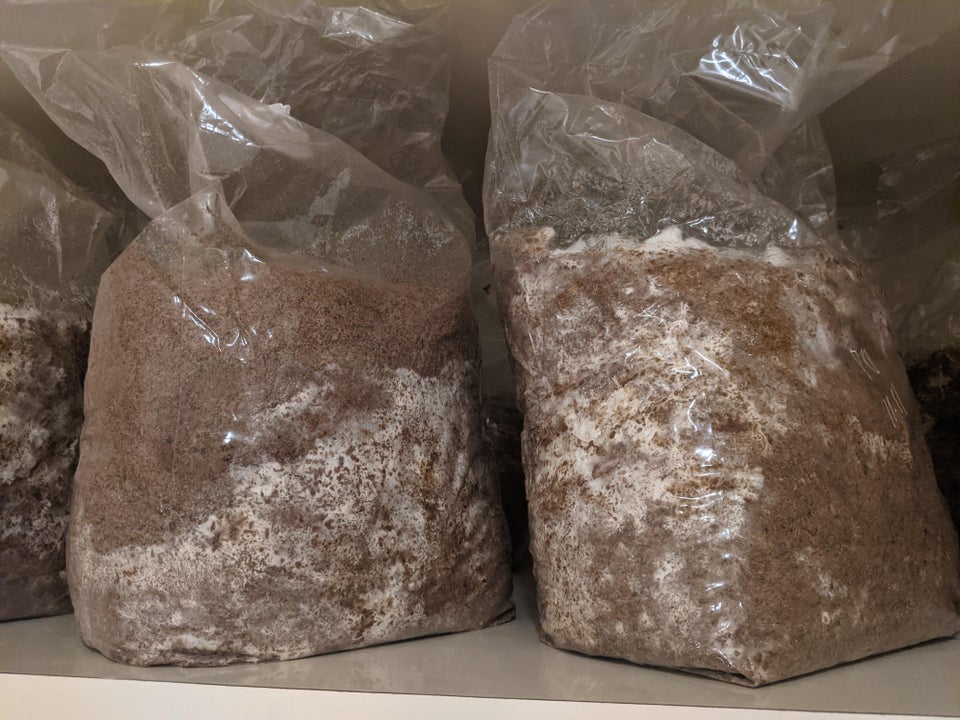
Keep the block at a temperature above 20 °C and start fruiting once it is completely colonized.


